Sunday, August 3, 2014

Continental climate divide - Breaking barriers, building common ground

This is the third and final part of my review of American Nations: A History of the Eleven Rival Regional Cultures of North America by Colin Woodard, a seminal book about the real political boundaries of the continent. The last installment delved into the divide on climate and global warming between progressive and recalcitrant regions. This piece looks at how to break through politically in the latter.   For basics on what distinguishes the 11 "American Nations" see part 1.

The gargantuan visage of Idaho Senator Larry Craig pours out from the movie theater-size screen at Boise’s conference center. It is 2003, long before Senator Wide Ride became famous for other encounters.  This day, fortunately for us boys in the men's room, he is coming in by satellite from DC.  Craig is talking about Idaho’s opportunities to prosper with clean energy sources such as wind and biodiesel.

The event was the third annual conference of a Northwest-based program I helped create called Harvesting Clean Energy.  The program was founded on the idea that farmers and rural communities have an economic interest in clean energy. Even if they didn’t believe in global warming they could be enlisted in the solutions.  Over the years we moved the conference all over the Northwest. We always made sure to invite the hosting state’s governor and congressional delegation, whatever the party affiliation. We worked with all kinds of folks, even climate skeptics. 

With a couple of exceptions all the conferences took place east of the Cascade Mountains, the part Colin Woodard dubs Far West in American Nations.  It didn’t take Woodard to tell us East of the Mountains is a different country culturally. In the Northwest you have to go east to get to the real west.  We knew global warming was as a tough a sell on the other side of the Cascade Curtain as clean energy opportunity was attractive.   So we focused Harvesting Clean Energy on the opportunity.  This is how you work on climate in the Far West, by crossing political divides and looking for common ground.  Even if you don’t talk much about global warming you’re focusing the solutions. 

The concept proved a stunning success.  The previous 2002 conference in Pasco, Washington inspired Idaho Republican Senator Mike Crapo to sponsor the first ever Energy Title of the Farm Bill.  Crapo’s engagement was vital to passage. Over $2.6 billion has been appropriated to farm clean energy under the title. From 2003-12 just one piece of the Energy Title, the Renewable Energy for America Program, put nearly $400 million into farm energy efficiency, manure biodigesters, wind, solar and other clean energy projects.  That leveraged over $1 billion in private investment from 2008-12 alone.  Even in these harshly partisan times, the Energy Title was renewed again this year with bipartisan support.

That contrasts sharply with the partisan divide over climate.  The federal climate bill failure in 2010 has left the only possibility for federal-level climate action with the Executive Branch, as Obama has done with vehicle fuel efficiency and coal plant emissions regulations.  The current deadlock in Congress shows no signs of breaking, and may indeed harden with unfavorable results for Democrats in the 2014 U.S. Senate races.  It seems that the summer Arctic Ocean will be ice-free and covered by blue water before Congress gets around to passing a bill to limit carbon pollution. The 2020s or something like that.

The contrast illustrates how to make progress reducing carbon pollution even in regions which resist seeing carbon as a problem. Find common ground around common values and interests.  In the case of carbon and climate, build common ground on renewable energy.  We may not converge on climate, but we can all agree that we like the jobs and energy independence generated by wind, solar and other renewable energy sources. 

This is one of those backdoors where political opposites can meet and make alliances, even create some friendships by actually talking to one another (a declining tendency in our centrifugal politics). John Aziz’s article,  “How the Tea Party came to love solar energy,” calls out, “Tea Party-leaning conservatives who like the idea of decentralized energy independent of big corporations and government. The Tea Party group supporting Barry Goldwater Jr. — a former California congressman and son of the presidential candidate of the same name — founded the lobbying organization Tell Utilities Solar won't be Killed (TUSK), which started off by fighting solar fees in Arizona, but has since expanded to Oklahoma and the rest of the United States.”

Republican Gov. Mary Fallin ultimately signed the Oklahoma solar fees bill.  But she also issued an unanticipated executive order revealing the group’s influence. Fees should only be imposed as a last resort and solar expansion should be a continued priority, the governor told the state energy commission.

Could renewable energy be a keystone for a broader grassroots populist alliance in regions of the country resistant to climate action?  Consider that the three “American Nations” Woodard cites as the most recalcitrant on climate were also the homeground of the 1890s Populist Party, the most vigorous movement against concentrated corporate power in U.S. history.  Take a look at the two maps below. 

The first map depicts Woodard’s “American Nations.”  As noted in part 2 of this series, Congressional representatives from Deep South, Greater Appalachia and Far West were lined up hard against the federal climate bill when it came up in 2009.  
The second map shows the electoral geography of the 1896 election when Democrat-Populist William Jennings Bryan ran against Republican William McKinley.  In an almost complete flip between today's blue and red states, support for Bryan and progressive change centered in those same three Southern and Western regions. 

The Populists brought together farmers, small business people and grassroots progressives to fight the power of railroads and banks.  Though not immediately successful the Populist Movement laid the foundation for the reforms of the early 20thcentury Progressive Movement.  Regulation of railroads, antitrust actions against monopolies, popular election of U.S. senators, progressive income taxation, popular initiative and referendum, are signature changes the Populists forwarded and the Progressives implemented.  The 1890s movement created the political space that made change in the 1900s and 1910s possible.   

In at least one critical aspect the grassroots right is resonant with the 1890s movement. It is suspicious of the concentrated financial power of Wall Street, and of concentrated corporate power in general. In fact 2010 election polls shows that most voters who blamed Wall Street for the economic mess voted Republican – 57% to 41%.   They thought the Democrats were too close to Wall Street. It is easy to point to the many ways these same powers manipulate the grassroots to do their bidding.  Completely true. But nonetheless the grassroots right doesn’t have it wrong when they see the Democrats in bed with finance capital.

As historian Judith Stein documents in her book, Pivotal Decade: How the United States Traded Factories for Finance in the Seventies, “Beginning in the 1980s, the financial services industry found a home in FDR’s party.”  She recalls that under the Clinton Administration, the barrier in place between commercial and investment banking was breached with the repeal of the Glass-Steagall Act on the books since 1933.  Financial derivatives trading was deregulated.  These changes substantially created the 2008 meltdown. The fire was set by Bill Clinton. George Bush only threw gasoline on it. 

Then Obama’s economic team appointments of Tim Geitner and Larry Summers, with uber-Wall Streeter Robert Rubin in the background, underscored the closeness of the Democrats to the financial industry.  Arguably the architects of the meltdown were called in to put out the fire, which they did with trillions of dollars in cheap capital fed to the banks. That disproportionately benefitted the top income classes of coastal regions and left most of the heartland behind, stuck with a stagnant industrial and agricultural base.  The 2010 Republican sweep was a vote against these economics, as much as anything. 

The Republicans can ride neo-populist anger against elites, but they ultimately serve the same.  What is needed is a new progressive populist force on the ground, not only in the old populist regions but in all regions of the U.S. including the climate-swing regions of The Midlands and Tidewater.  This new progressive populism must be centered on economic issues.  Like the 1890s movement it must focus on wealth inequality and how to narrow the gap. 

Left to the devices of Wall Street and the corporate economy, many regions of the U.S. will be consigned to economic decay and abandonment.  Wide swathes of the U.S. are in this condition, including much of the Southern and Western geography where the grassroots right is strong.  Common ground might be found in an economic vision rooted in restored self-reliance based on local and regional initiatives and institutions. 

A broad vision for local and regional economic renewal starts with renewable energy.  Energy is the foundation of economic prosperity. Economic self-reliance based on regionally produced renewable energy clearly follows. A new populism can focus the message by forwarding rapid transition to 100% renewable energy.  The solar panel, wind turbine and electric vehicle can become icons for an independent path to economic prosperity.  

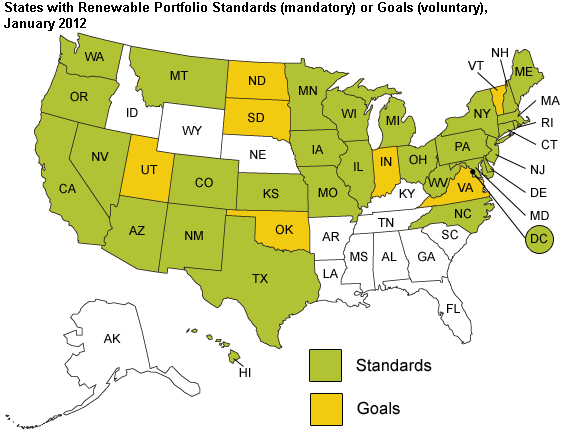
The map below demonstrates the broad ground for renewable energy in the U.S.  It shows states with Renewable Electricity Standards covering most of the country.  The major reason the South is blank is because wind power has been the primary means of meeting standards, and the South is wind poor.  With the coming of cheap solar panels the local energy richness of the South will come to the fore. 

Focus on 100% renewable energy leads to a broader issue that is at the heart of regional economic renewal.  Fundamentally, it is all about capital, about investing money in building a new economic base, one that holds money at home and plugs leakage to Wall Street and fossil fuel corporations. To accomplish this we need to develop a series of new local and regional institutions that make up what Gar Alperowitz calls the Pluralist Commonwealth in his book, America Beyond Capitalism; Reclaiming Our Wealth, Our Liberty and Our Democracy.  

The book calls to a kind of post-capitalist entrepreneurialism rooted in organizations such as employee-owned businesses, community development corporations, state banks and public investment funds.  It is a profoundly decentralist vision that calls for the de-concentration of economic power and development of new wealth-creating institutions on local and regional economic landscapes.  Not an abstract theorization, the book is rich with examples of where this is already happening, from the State Bank of North Dakota to employee-owned Parametrix, an environmental consulting firm based in Sumner, Washington.  

The concept of local and regional economic renewal based on the development of democracy-based institutions could build a new common ground. This hearkens to the original Populist Movement, which originated the idea of farmer cooperatives. They are now a major force in American agriculture.  Progressive populist movements that forward transformatory economic visions for their own regions can open new political space.  

This is not an overnight project.  Much as the 1890s Populists opened the way for the early 20th century Progressives, so a rooted progressive populist movement can build the ground for change in the 2020s and beyond.  And focusing a 100% renewable energy message can immediately begin to move the ball on the most vital climate solution, even in regions and among people where climate change is denied.  

While global warming is a divisive issue, support for renewable energy is broad and unifying.  Let us focus on building common ground, and in the process create political space for the broad democratic and economic renewal that is so urgently needed in American life.   

Saturday, July 26, 2014

A Washington State climate policy that does the carbon math

Question: What would a climate policy look like that actually meets carbon reduction goals determined by science?

Answer: Carbon pollution from fossil fuels would be cut far faster and far deeper than is contemplated in climate policies now on the books or under consideration.

Washington State is currently moving toward a climate policy to cap statewide carbon emissions.  Gov. Jay Inslee’s Carbon Emissions Reduction Taskforce (CERT) will hear the proposed policy design in a meeting Tuesday.  It will inform the governor’s proposal to legally limit carbon pollution.  He is expected to put it before the legislature next year.

The effort builds on non-binding carbon goals set in 2008 legislation, SB6001. The bill, even when it passed, did not meet what science indicated was needed to stem global warming. It set a goal of only 50% carbon reductions by 2050 when 80% was the generally understood target. Now the science has moved even further, and global warming impacts are accelerating beyond the expectations of even just a few years ago.  Washington’s carbon goals must move with the science, and the times.

A recent article by James Hansen and his colleagues sets the bar for what a carbon reduction policy should require. Arguably the world’s top climate scientist, Jim Hansen has authored a landmark.  Of his many seminal journal articles, this one may prove to be the most important.   “Assessing ‘Dangerous Climate Change,’” provides the carbon math that must guide policy.

The key points:

The source of global warming is an energy imbalance.  More solar heat is entering the Earth’s atmosphere than leaving it.

The way to even the balance is by reducing the capacity of the atmosphere to trap heat.  That means cutting emissions of heat-trapping gases, primarily carbon dioxide.  Achieving balance will require reducing atmospheric CO2 to 350 parts per million (ppm). CO2 is now around 400ppm and climbing fast. 

Achieving 350ppm by 2100 will require holding total fossil fuel carbon emissions to 500 billion metric tons, or gigatons (GtC), and soaking another 100GtC from the atmosphere into trees, other plants and soils.  Humanity has released 370GtC, so our remaining carbon budget is 130GtC

Staying within our carbon budget requires immediate carbon reductions of 6% per year.  The longer we delay the higher that annual percentage becomes and the greater will be the warming. 

The graph below illustrates how choices we make now will echo across the centuries.  The dotted line is the 350ppm point at which the atmosphere has crossed the line back into balance.  The left-hand graph shows the effect of the Hansen goals for 6% annual carbon reductions and natural carbon storage.  The planet is back in balance around 2100.  Contrast this with the solid blue line in the right-hand graph.  Even the still ambitious target of 5% a year delayed until 2020 pushes the balance point two centuries into the future to 2300. Note that the 450ppm carbon limit that has generally been accepted as the standard carbon boundary, the green line, does not produce climate balance even by 2500. Some curves reach out a millennium. If anything illustrates the urgency of deep carbon cuts beginning now, it is this graph:  


The scientists are not blind to the political difficulties. They note, “It is distressing that, despite the clarity and imminence of the danger of continued high fossil fuel emissions, governments continue to allow and even encourage pursuit of ever more fossil fuels. Recognition of this reality and perceptions of what is ‘politically feasible’ may partially account for acceptance of targets for global warming and carbon emissions that are well into the range of ‘dangerous human-made interference’ with climate. Although there is merit in simply chronicling what is happening, there is still opportunity for humanity to exercise free will. Thus our objective is to define what the science indicates is needed, not to assess political feasibility (emphasis mine).”

Nonetheless, Hansen and his colleagues add, deep and rapid carbon cuts are not beyond the realm of practicality.  “. . . it is not obvious to us that there are physical or economic limitations that prohibit fossil fuel emission targets far lower than 1000 GtC (the generally accepted goal in global climate negotiations – P.M.) even targets closer to 500 GtC. Indeed, we suggest that rapid transition off fossil fuels would have numerous near-term and long-term social benefits, including improved human health and outstanding potential for job creation.”

I asked a long-term colleague and one of the best carbon brains around, Roel Hammerschlag, to calculate the implications of a 6% annual reduction curve for Washington State in comparison with current goals.  Here is Roel’s graph:


The blue line shows the carbon emissions trajectory without policy change.  The dotted red line depicts Washington State carbon goals set under its 2008 climate bill,  The orange line plots the 6% annual carbon reductions curve for which climate science calls. 
Here are tables comparing the two sets of goals:

Annual CO2 Emissions in Metric Tons

2020
2035
2050
SB6001
66.67
50.00
33.34
Hansen
46.65
18.44
7.29


Percentage Reduction in Emissions Compared to 1990

2020
2035
2050
SB6001
0%
25%
50%
Hansen
30%
72%
89%

Note that the graph calls for its steepest emissions cuts between now and 2030.  This underscores the importance of immediate action. Each year adds to the accumulation of atmospheric carbon.  So hitting annual targets for carbon reduction as soon as possible is crucial to stem the carbon buildup and long-term effects.

Washington State is only a small part of the global picture.  But Washington is also a significant state in the nation that has put the most human-originated carbon into the atmosphere. The U.S. is responsible for 26% of the total. Washington also claims to be a climate leader.  To truly lead, Washington must adopt goals and policies that line up with the science.  This means going beyond SB6001 to adopt the Hansen 6% goal and with it an agenda to move Washington State off fossil fuels much more rapidly than current plans contemplate.

Rapid transition to 100% renewable energy, a comprehensive effort to retrofit most buildings for energy efficiency, and an accelerated move to electric vehicles are elements of the agenda.  Investments in forest carbon, soil-building agriculture and wetlands restoration add to the biological carbon storage side of the Hansen prescription.  Washington with its rich natural resources can make a disproportionate contribution in this area. The Northwest Biocarbon Initiative is advancing carbon-soaking land use practices.

It is not hard to understand why Washington must set a high bar for carbon cuts now.  Just think about 2100.  About how closely we are connected to the future. 

A 10-year-old in 2014 will have a child in 2029 when she is 25. 

Her child will bear her grandchild in 2054 when she herself is 25.

Her grandchild will have a daughter, also at 25, in 2079

Today's 10-year-old may well live to 2100. She would be 96. Her child will be 71 then. Her grandchild will be 46, her great grandchild 21.   

If we move now to achieve 6% annual carbon emissions cuts as soon as humanely possible and to leverage our landscape for biocarbon storage, their families could live in a world that has veered away from the worst danger.  Climate change will still be severe but beginning to stabilize.  

Or they might live in a world that remains in the danger zone for generations more, and where climate balance will not be achieved for centuries.   What we leave them depends on the choices we make today.  Washington State can choose to set carbon goals clearly indicated by science and model a climate leadership agenda for the world.  If that seems impossibly out of reach, just consider that 21-year-old. 


Sunday, July 20, 2014

In a U.S. flying apart, regional climate action is central

This is the second part of a review of American Nations: A History of the Eleven Rival Regional Cultures of North America by Colin Woodard, a seminal book about the real political boundaries of the continent.  This part covers the implications of regional divisions for climate change policy in the U.S. and North America.  I suggest that readers first take in part 1 for a basic description of the regions.

When the landmark federal climate bill narrowly passed the U.S. House of Representatives in 2009 it illustrated deep regional divides on global warming policy in the U.S.  For most of the country one could almost predict how a representative would vote by the region from which they hailed. 

“ . . . the measure received near-unanimous support in New Netherland, the Left Coast, and Yankeedom,” Colin Woodard writes, while “the Far West offered near-unanimous bipartisan opposition, joined by the overwhelming majority of Appalachian and Deep Southern lawmakers.”  The exception – “Tidewater and The Midlands were divided.” 


That perfectly expresses the regionality of U.S. climate politics, and one that continues to hold.  The U.S. would have a carbon-limiting framework if it were up to people in the three climate-supportive regions.  Indeed these are exactly the regions that are pioneering regional climate policy in the U.S.  New York and the New England states instituted the nation’s first carbon cap, the Regional Greenhouse Gas Initiative for power plants. California has the first economy-wide carbon cap in the U.S., while British Columbia has instituted a carbon tax. Efforts are underway to bring carbon limits to Washington and Oregon. 

Meanwhile states making up the Deep South and Far West are hotbeds of climate change denial and obstruction.  When climate policy strategists look for a winning pathway to resurrect a federal climate bill - the first effort died in the Senate in 2010 - they write off most representatives from these regions.  They look to swing votes from Tidewater and the Mid-Atlantic-to-Midwest swathe of The Midlands. 

An indicative exception is Colorado, much covered by El Norte.  Latinos when polled express greater concern about global warming than any other ethnic group (including non-Latino whites).  This bodes well for the future of climate policy in the Southwest. 

For the nation as a whole the picture is more troubling.  The centrifugal tendencies seen in the federal climate vote are only intensifying as U.S. regions spin off in sharply different directions.  Washington state studies the effects of sea level rise on coastal communities, while North Carolina bans discussion of the topic from coastal planning. 

“Few (regions) have shown any indication that they are melting into some sort of unified American culture,” Woodard notes.  “On the contrary, since 1960 the fault lines between these nations have been growing wider, fueling culture wars, constitutional struggles, and ever more frequent pleas for unity.” 

Of all issues, global warming seems to exhibit the most centrifugal tendencies.  A recent poll shows climate has become even more divisive than abortion.  While national, the regional breakdown is predictable.   The increasing inability of Americans to agree on climate and a range of other topics has frozen action at the federal level.

In complete contradiction to the political gridlock, the acceleration of global warming impacts urgently calls for action.  It seems a hopeless dilemma for climate advocates, who do the best they can working at state and local levels.  If anything, the situation should underscore the critical importance of enacting effective state and local climate frameworks. 

There are two ways to look at state carbon policy efforts.  One sees passage of state policies as primarily significant in building momentum to eventual federal action.  So the internal efficacy of the policy is not so important as the larger political and symbolic impact.  The second sees state policies as important not only for the potential larger impact, but also as significant policy measures to achieve substantial carbon reductions on their own.  So efficacy of the policy becomes a prime consideration.

We should hope that enacting policies in states such as Oregon and Washington will provide national momentum, and that the national picture will improve sufficiently to pass federal policy by 2018 or so.  But with prospects for a Republican Senate in 2014, continued national divisions and an uncertain 2016 presidential result after eight years of a Democratic White House, conditioning state policy design on national policy success is a risky game.  It may be the 2020s before a federal carbon limit can pass.

Thus state carbon policies must be designed to be internally effective.  In other words, they should be geared to reduce state carbon emissions to levels consistent with the need to keep overall global temperatures under 2°C, the line at which catastrophic feedbacks become likely.  It should not be assumed that state policies have prime significance as leverage points to pass an eventual federal policy that will really get the job done.  State policies should fully model what a federal policy should do in terms of carbon reduction necessities.  Their successful implementation in ways that demonstrate actual economic benefits will be the most powerful driver for passage of national climate policy.

Economic success is crucial.  Pro-climate states must show they can outcompete anti-climate states in the marketplace. They must demonstrate that policies that cut carbon provide better economic performance by improving efficiency and bringing new technologies to bear.  There are many studies that indicate this is the case, for example with the BC carbon tax.  

That leads to a further critical point.  State and provincial policies can go far to reduce carbon emissions.  But to reduce emissions deeply enough and fast enough to stay under that 2°C limit is highly challenging.  Emissions must be reduced at least 2 percent annually over a long period, and cuts of 6 percent per year would be required to stabilize climate by 2100. Accomplishing these goals with carbon caps and pricing alone could raise competitive difficulties and shift polluting activities to other nations.  See these posts on BC and Britain. 

Climate policy opens another avenue though, generation of substantial revenues. For a carbon framework to have a realistic chance of meeting the 2°C goal, a significant share of the revenues must be invested in effective low-carbon solutions.

The most effective would be to create a large pool of low-cost capital to finance mass-scale, deep energy efficiency retrofits that capture opportunities at a 20-year rate of return, rather than the general 3-year low-hanging-fruit projects that typify efficiency investments.

Large loan guarantee pools could de-risk private capital investment in low-carbon solutions including renewable power generation, power grid modernization, sustainable fuels production and agricultural practices that build soil carbon. 

A tremendous upgrading of transit and options to auto travel by individual drivers is also a high-return low-carbon investment.  Options can include van and ride pools, telecommuting, bicycle and pedestrian access, and measures to site housing close to jobs.

Investments in forest carbon storage, whether by outright public purchase or conservation easements, are highly necessary for climate stabilization.  Financial models that govern industrial forestry will not allow the long harvest rotations needed to adequately increase forest carbon reserves. Buying forest carbon in competition with board feet becomes expensive and can only go so far. 

These investments would  build state economies and new economic sectors.  States and regions can make themselves investment engines to build new low-carbon economies that indeed do demonstrate the competitive edge of pro-climate states. 

There will be large temptations to use carbon revenues for many other underfunded needs of fiscally pressed state governments, such as education, or to simply rebate the money, as does BC.  Some level of rebating is needed to defray the impacts of higher energy prices on low- and middle-income people.  Meeting state funding gaps is another important goal, but this should not be done on the back of climate policy.  Elected leaders must offer overall revenue solutions. Carbon revenues should be spent on carbon reduction. 

In a nation seemingly flying apart on multiple issues, none more than climate change, it is crucial that state and regional policies do the most effective job they can.  They must be designed to meet ambitious carbon reduction goals consistent with the needs of climate stability and our children’s generations.  Let us hope that eventually the national balance will tip to an effective carbon limit.  But for now in a U.S. that is flying apart, state and regional climate policies are central.  They must be made to work as if they are the only game in town. For some years to come they probably are. 

The final installment will cover how to win on climate in the climate-intractable regions of Far West, Greater Appalachia and Deep South, as well as in swing regions The Midlands and Tidewater. The imperative is to join in building a broader progressive coalition advancing economic justice and democracy, one that makes rapid clean energy transition a key goal to achieve those ends.